
Handmade Jewelry in Germany: A Thoughtful Buyer’s Guide
When searching for handmade jewelry DE, look beyond polished photographs and marketplace labels. Ask what materials a piece uses, which steps are done by hand, and who made it. A clear account of how the jewelry comes together is more useful than a general claim of craftsmanship.
It’s natural to want jewelry that feels individual and carries meaning. It’s just as reasonable to want specifics, from the materials in a piece to the maker’s role and the seller’s production details. A beautiful intention matters most when it feels personal, not when it rests on vague ethical or spiritual promises.
This guide explains how to assess craftsmanship, materials, design, and seller transparency before choosing handmade jewelry in Germany. You’ll find practical checks for comparing listings, questions to ask when details are missing, and ordering terms to review before you buy. The goal is to choose a piece that feels right in both its making and its meaning.
Key Takeaways
- Assess handmade jewelry DE beyond the marketplace label: check construction, material descriptions, maker information, and care guidance.
- Use close-up images and detailed listings as clues, not proof on their own. Compare what each seller explains about the specific piece.
- Before ordering, check the product details and confirm current delivery options, timing, and order terms for Germany.
- Choose a piece whose materials, design, and intended meaning feel personally relevant, without relying on broad ethical or spiritual promises.
- ZAAFAR Atelier brings traditional South Asian craftsmanship together with modern, gratitude-inspired design through its Hamburg- and Pakistan-based story.
What Makes Handmade Jewelry in Germany Meaningful to Choose?
Product photography can show a piece’s shape, colour, and finish. It can’t tell you who made it, which steps were done by hand, or what materials went into it. Those details matter because “handmade” can describe different production approaches. The label alone doesn’t tell you how a piece was made or how carefully it was finished.
Handmade jewelry is shaped, assembled, or finished through human craft, with the specific methods depending on the maker. For shoppers exploring handmade jewelry DE, meaning comes from looking beyond appearance. Consider whether the design resonates with you, whether the material information is clear, and whether the maker explains their role in creating the piece.
What does handmade jewelry actually mean?
Handmade describes an approach to production, not one universal technique or quality grade. A maker might assemble components by hand, finish a piece by hand, or use a craft process such as embroidery. These terms aren’t interchangeable, so look for a description of the actual steps instead of assuming what “handmade” means in a particular listing.
A useful listing names the maker or collaborators, describes the process, and connects those details to the item being sold. Product descriptions and close-up photographs can help you understand the work, but neither automatically verifies every claim. Treat a broad marketplace label as a starting point for questions, not as evidence on its own.
Why do shoppers in Germany seek artisan-made pieces?
An artisan-made piece can feel individual because its design reflects choices made during its creation. Visible details, such as embroidery or a distinctive arrangement of materials, may invite a closer look. A personal connection can come from the form, the craft tradition, or the meaning you choose to associate with the jewelry. That meaning is yours to define, not a promised effect of wearing it.
Contemporary design can also bring cultural craft traditions into a modern wardrobe. ZAAFAR Atelier, founded and designed by Saadia Zaafar, brings together modern, spiritually inspired design and traditional South Asian craftsmanship. Its craft story includes traditional hand-embroidery techniques. The Festive Royalty Necklace craft story offers a closer look at how artisan work informs a named piece.
Germany also has a place in the history of modern art jewelry, including the development of the field through designers and institutions in the 1950s and 1960s. That context can deepen appreciation, but your practical guide remains the maker’s clear description of process, materials, and design intent.
How to Assess Handmade Jewelry DE: Craft, Materials, and Maker Transparency
A useful assessment looks past the word “handmade” and asks what you can confirm. When comparing handmade jewelry DE listings, use the same four checks each time: construction, materials, maker information, and care guidance. This makes it easier to compare pieces on the details sellers provide, rather than on atmosphere alone.
Specific craft details are more useful than a handmade tag. A listing can support a claim with clear, consistent information, though its wording and photographs still aren’t independent proof of every production detail.
Which product details help verify craftsmanship?
Look for a named technique and an explanation of where it appears in the piece. If a maker mentions hand embroidery, for example, check whether the description says which part is embroidered. Close-up views can help you inspect visible finishing, joins, edges, and how components are attached. They show what the seller has chosen to photograph, not necessarily how every part was made.
Check whether the listing identifies the designer, maker, or craft collaborators and explains where production takes place. Then look for care guidance that fits the stated materials and construction. A missing or generic detail isn’t proof of poor quality, but it is a reason to ask before ordering. Does the description apply to this specific piece? Who carries out the named process?
How should shoppers assess jewelry materials?
Compare material names across the product title, description, and specifications. Look for precise terms rather than broad phrases such as “natural materials” or “precious finish.” If a metal, bead, stone, or textile isn’t identified clearly, ask what it is and which parts of the piece it describes. This helps prevent one attractive detail in the copy from being mistaken for a complete materials list.
ZAAFAR Atelier names Rudraksha beads and quartz among the materials it uses, but that doesn’t establish that either appears in every piece. Confirm material details on the individual product listing before deciding. Its craft story also includes traditional hand-embroidery techniques, so check whether a specific listing explains if or how that technique is used for the item.
Keep product facts separate from interpretation. Material names, stated construction, maker details, and care instructions are claims you can ask the seller to clarify. Words such as “protective,” “energising,” or “healing” express meaning or belief; they don’t establish a medical outcome or guaranteed spiritual effect. A talisman may hold personal significance without promising a particular result.
For a practical example of how a brand presents its craft and design, explore the atelier’s jewelry designs, then compare each product’s details with this checklist.
Handmade Jewelry Marketplaces vs. Artisan-Led Brands: What Should You Compare?
Marketplaces and independent, artisan-led brands can both help you find handmade jewelry, but they support different kinds of shopping. A marketplace makes it easier to browse across sellers and styles. A focused brand may offer more context about a particular design perspective. Neither format proves craftsmanship by itself, so compare the information available for the specific piece and seller.
| What to compare | Marketplace | Artisan-led brand |
|---|---|---|
| Discovery | Often useful for exploring a broad mix of styles and makers in one place. | Usually centers discovery on one brand’s designs and point of view. |
| Maker information | May vary by seller, so check the individual profile and listing. | May provide a more connected account of the founder, makers, or craft context. |
| Product detail | Assess the materials and process described on each product page. | Look for product-specific details, not only general brand storytelling. |
| Buyer policies | Review the seller’s terms as well as any platform-level information. | Check the brand’s own current order and delivery terms before buying. |
When is a marketplace useful for finding handmade jewelry?
Broad browsing can help when you’re still discovering which silhouettes, materials, or makers appeal to you. Use platform categories and search filters to find options, then assess each listing. Does it explain the piece’s construction, identify materials, and say who made it? Marketplace-level language about independent creators can guide discovery, but it can’t replace product-specific information or explain every seller’s process.
When might an artisan-led jewelry brand be a better fit?
A focused brand can make it easier to follow a coherent design philosophy and understand how craft informs its work. ZAAFAR Atelier has a presence in Hamburg and Pakistan. That context doesn’t, by itself, confirm where an order is fulfilled or how it will be delivered. Check product information and current ordering terms separately. If meaning-led design interests you, explore this guide to mindfulness jewelry.
Choose the route that matches your priority. If variety matters most, start with marketplace browsing. If you want a connected design story, explore artisan-led brands. If material detail is your deciding factor, let the clearest product-level information guide you, wherever you find it. For handmade jewelry DE, the useful comparison isn’t which channel is universally better, but which seller answers your questions with relevant, specific information.
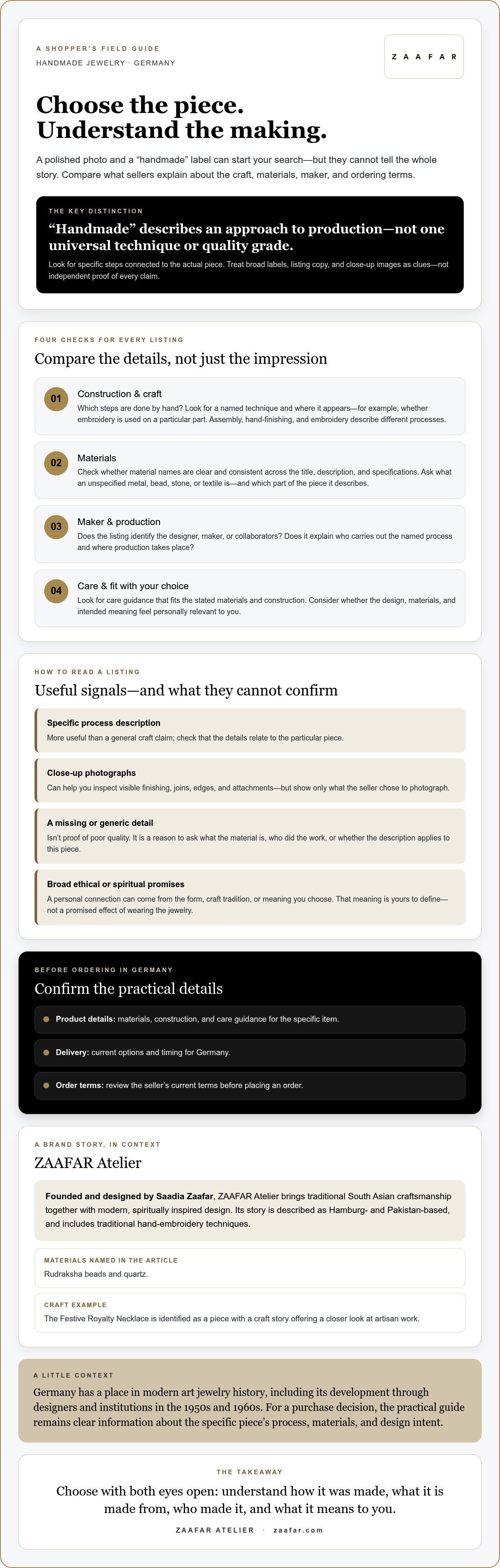
What to Check Before Ordering Handmade Jewelry in Germany
A few clear checks can help you move from an appealing listing to a confident choice. Before ordering handmade jewelry in Germany, review the exact product details and the seller’s current terms. Don’t assume delivery, return options, or timing based on a brand’s location or general marketplace information.
Which questions should you ask before buying?
Use this checklist for the specific piece you’re considering. If an answer is missing or unclear, ask the seller before placing your order.
- 1. Confirm materials and techniques. Which materials and craft processes apply to this exact item? Check that the product description identifies the parts or details each term refers to.
- 2. Check dimensions and fit. Review stated measurements and consider how the piece should sit or feel when worn. For a gift, compare the information with something the recipient already wears, if possible.
- 3. Review care guidance. Look for instructions that suit the listed materials and construction. If guidance is absent, ask how the piece should be stored, cleaned, or protected during wear.
- 4. Study the product photographs. Check whether the listing shows useful views of the piece and the details that matter to you. If colour, scale, or a particular feature is unclear, ask the seller how the images represent the item.
- 5. Confirm order terms for Germany. Check current delivery options, estimated timing, shipping information, return terms, and how to contact the seller with a question. Read the terms that apply to your order rather than relying on a general statement elsewhere.
How can you choose a piece for everyday wear or gifting?
Think about the person and the occasion before choosing a design. For everyday wear, consider whether the scale suits their style and whether the stated care needs fit their routine. For a gift, look for clear measurements and materials, and check that the design feels like something the recipient would choose for themselves.
Meaning can make a piece feel more personal, but symbolic associations aren’t universal. A motif or material may hold significance for one wearer and simply appeal aesthetically to another. Let the design’s meaning resonate with you or the recipient, without assuming it promises protection, well-being, or a particular spiritual outcome.
Once you’ve reviewed the product facts and current order terms, explore ZAAFAR Atelier’s designs and consider which piece feels aligned with your style and sense of meaning.
Discover ZAAFAR Atelier’s Handmade Jewelry and Artwear
ZAAFAR Atelier is a Hamburg- and Pakistan-based jewelry and accessories brand founded and designed by Saadia Zaafar. Its work brings traditional South Asian craftsmanship into conversation with contemporary, spiritually inspired design. For shoppers exploring handmade jewelry DE, the brand offers an example of how a maker’s background and creative intentions can add context. Each product’s own description remains the place to confirm its materials and details.
The collection includes necklaces, bracelets, a bead ring, a shoulder adornment, a bodysuit, and an emerald belt. Rudraksha beads and quartz are among the materials the brand uses, but their presence shouldn’t be assumed across every item. Check the individual product information to see which materials and techniques apply to the piece you’re considering.
How does ZAAFAR bring South Asian craft into modern design?
The brand’s story connects South Asian master craftsmen and traditional craft knowledge with a contemporary design language. Traditional hand embroidery is part of that craft story, but that doesn’t mean every product uses embroidery. Look for product-level information to understand which techniques apply to a particular piece.
ZAAFAR describes its jewelry-making technique as patented. That description is part of the brand’s account of its work. Confirm the precise scope of the patent before drawing conclusions about which process or products it covers. This distinction is useful for any buyer: brand context can explain creative intent, while specific claims still benefit from clear supporting detail.
Craftsmanship also has a human dimension. The brand says it works with South Asian master craftsmen. This gives shoppers context about the people and traditions informing the work, without by itself establishing broader claims about sourcing or social impact.
How can intentional jewelry become part of a personal ritual?
ZAAFAR presents its jewelry as a reminder to practise gratitude. A wearer might use that intention as a quiet moment of reflection when putting on a piece, or simply appreciate the design as a personal symbol. The meaning can be personal without promising healing, protection, or a measurable change in well-being.
For another perspective on symbolic design, read the copper talisman bracelet guide. As you browse, compare each item’s stated materials, dimensions, care guidance, and design details with what matters to you. Explore ZAAFAR Atelier’s jewelry and Artwear at your own pace, and let the piece’s craft and meaning speak for themselves.
Choose a Piece That Feels Considered
A thoughtful purchase begins with clear details. Look beyond the handmade label: check the construction and materials, learn who made the piece, and review its care guidance and the seller’s current terms for Germany. Compare listings at the product level, since a marketplace or brand story alone can’t confirm every detail.
For handmade jewelry DE, let both the practical facts and your personal response guide you. Choose a design, material, and meaning that feel right to you, without relying on broad promises about ethical impact or spiritual effects.
ZAAFAR Atelier was founded and designed by Saadia Zaafar, with a presence in Hamburg and Pakistan and influences from South Asian craftsmanship. Rudraksha beads and quartz are among the materials used in its jewelry work. Check individual product details to confirm whether either appears in a particular piece.
Explore ZAAFAR Atelier’s handmade jewelry and Artwear, and review the product details that matter to you before choosing a piece.
Frequently Asked Questions
What qualifies as handmade jewelry?
Handmade jewelry is made through human craft, but the techniques and amount of handwork can vary from one maker or piece to another. One item may involve hand assembly, while another may be shaped or finished by hand. The label isn’t a quality guarantee. Look for a specific description of construction, finishing, and materials. Clear process details help you understand what distinguishes the piece and what the maker actually did.
How can I tell if jewelry is genuinely handmade?
No single sign proves that every component was handmade. For handmade jewelry DE, compare the maker’s process description with product-specific images, visible construction details, and consistent material information. Check whether the seller explains who makes the piece and which steps involve handwork. If details are missing, ask direct questions about the exact item. A handmade label alone doesn’t confirm its provenance, production method, or quality.
Is handmade jewelry more sustainable than mass-produced jewelry?
Handmade production alone doesn’t establish a piece’s overall environmental impact. To assess a sustainability claim, look for specific information about the materials, how the piece is produced, its expected durability, and where its components come from. These details may differ between items, even from the same maker. Treat broad phrases such as “eco-friendly” as claims to examine, and look for evidence supporting the exact wording rather than assuming handmade means sustainable.
Are Rudraksha beads and quartz used in handmade jewelry?
Yes, both Rudraksha beads and quartz can be used as jewelry materials, and ZAAFAR Atelier identifies them among the materials used in its work. Their presence can vary by design, so check the listing for the specific piece rather than assuming either material appears throughout the range. Some people associate these materials with spiritual or cultural meanings. Such associations can be personally significant, but they aren’t evidence of medical effects.
How do I choose handmade jewelry for everyday wear?
Choose a piece that suits your routine as well as your style. Consider its dimensions, materials, comfort, care instructions, and how it fits with the clothes you wear regularly. Review product images and measurements, then ask the maker about maintenance if the guidance is unclear. If the design has symbolic meaning, consider whether it resonates with you personally. Interpretations vary, so you don’t need to adopt a universal meaning.
Can I order handmade jewelry from an international brand in Germany?
Whether you can order depends on the brand’s current delivery options and purchase terms. Before checkout, confirm that Germany is included, review the delivery information and estimated timing, and check the return conditions and available customer support. Don’t assume that a brand’s location tells you where an order ships from or what terms apply. Review the details shown by the seller at checkout, including any applicable charges or conditions.
What should I check before buying handmade jewelry online?
Review the exact product’s materials, dimensions, construction description, care instructions, seller identity, and photographs. Check whether the images and written details answer your questions about the piece, then confirm delivery and return terms for your location before buying. If a craft, sourcing, or meaning claim matters to you, ask the seller for clarification about that specific item. This gives you a clearer basis for choosing than a broad label or promise alone.