
Minimalist Spiritual Jewelry: The Art of Subtle Intention and Modern Protection
Can spiritual jewelry feel refined and modern without losing its deeper meaning? It can. Minimalist spiritual jewelry brings a deliberate form, material, or symbol together with personal intention. The result can be a quiet reminder that fits into your day without dominating your look.
If spiritual pieces have felt too ornate, overly thematic, or disconnected from the hands that made them, your hesitation makes sense. A good fit should suit your personal style and carry a meaning you value. Materials deserve thoughtful consideration too: copper, Rudraksha beads, and quartz have cultural and personal associations, but those meanings are not a substitute for clear material information or your own discernment.
This guide will help you choose a daily piece by considering design, material, symbolism, comfort, and the story behind its making. You’ll also find practical questions to ask when looking for work made with care for artisans. ZAAFAR Atelier’s handmade artwear, including the Midline Copper Bracelet – Minimalist Protection Talisman, brings contemporary form into conversation with spiritual practice and South Asian craftsmanship. A subtle piece can hold a meaningful reminder of protection, gratitude, or a moment to return to yourself.
Key Takeaways
- Start with the intention you want to carry, then choose a design that feels comfortable and suits your everyday style.
- Explore the cultural and personal associations of materials such as copper and Rudraksha beads, while distinguishing symbolic meaning from guaranteed effects.
- Look beyond appearance: find out what a piece is made from, who made it, and what its craftsmanship involves.
- ZAAFAR Atelier’s artwear brings South Asian craftsmanship and contemporary design together, with gratitude as a guiding intention.
- The Midline Copper Bracelet – Minimalist Protection Talisman is one example of a subtle piece designed to carry meaning without overwhelming your look.
The Evolution of Quiet Spiritualism: Why Minimalist Spiritual Jewelry Matters Now
Spiritual meaning doesn’t need to announce itself across a room. Minimalist spiritual jewelry brings clean design and personal intention together, offering the wearer a quiet reminder rather than a message everyone else must read. This isn’t a rejection of expressive symbols. Large crosses, hamsas, and other visible emblems carry histories and meanings of their own. Minimalism offers another way to wear intention, one that may focus on a material, a shape, or a private ritual instead of a prominent icon.
For many people, the appeal of a simple piece lies in what it means to them, not in how clearly it signals status or spirituality to others. Fewer competing details can also make one piece easier to notice during a busy day. If you want jewelry that feels personal but understated, consider whether you’re drawn to a visible symbol, a discreet shape, or a material with meaning for you.
From Symbols to Energy: A New Design Paradigm
For some wearers, meaning begins not with a literal symbol but with the material itself. Copper has practical qualities and cultural associations; spiritual interpretations of it are beliefs, not guaranteed effects. The wider history of protective amulets shows how varied cultures have used meaningful objects as reminders or emblems of protection. Minimalist design offers another way to carry that impulse without requiring a large or explicit motif.
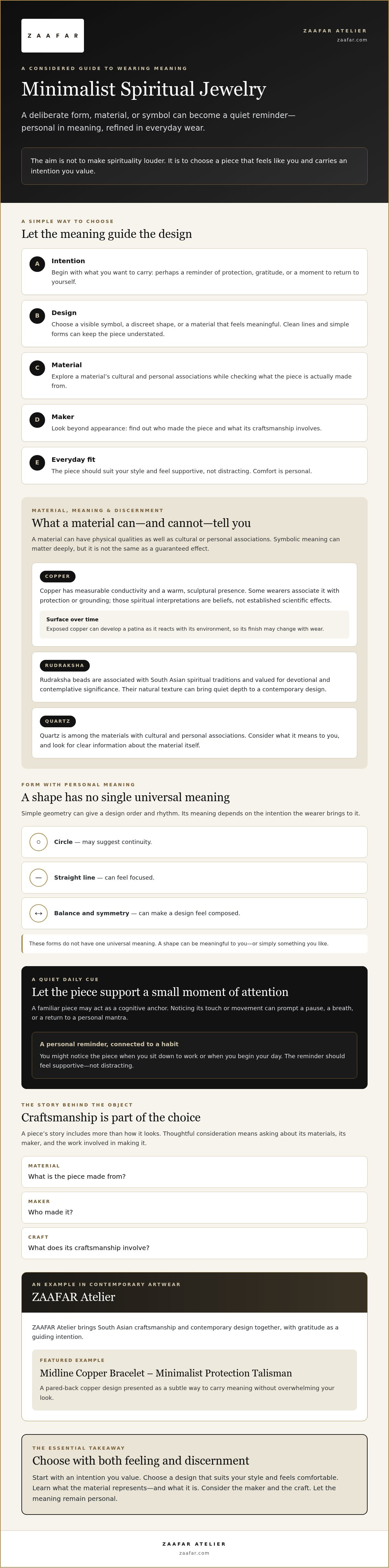
Clean lines can suggest clarity, while geometry gives a piece order and rhythm. A circle may suggest continuity; a straight line can feel focused; balance and symmetry can make a design feel composed. These forms don’t have one universal meaning. Their value lies in the intention the wearer brings to them. When comparing designs, ask whether a shape feels meaningful to you or whether you simply like its appearance. Either can be a valid reason to choose it.
The Psychology of Wearing Intentional Pieces
A familiar piece can serve as a cognitive anchor: noticing it may prompt a pause, a breath, or a return to a personal mantra. A bracelet’s contact with the wrist or a pendant’s movement can provide a tactile cue to come back to the present. Physical weight may also feel grounding, though comfort is personal. The piece should feel supportive, not distracting.
Minimalist spiritual jewelry can be a discreet reminder to reconnect with a chosen intention during everyday moments. To make that reminder useful, link it to a simple habit, such as noticing the piece when you sit down to work or when you begin your day.
Intentional Materials: The Soul of Minimalist Talismans
In minimalist spiritual jewelry, a material can carry meaning without a prominent emblem. Copper’s conductivity is a measurable physical property; its associations with protection and grounding belong to spiritual traditions and personal belief, not established scientific effects. That distinction doesn’t diminish its symbolic value. It helps you choose with discernment, appreciating both what a material is and what it represents to you.
Copper as a Minimalist Protection Talisman
Copper has a warm, sculptural presence that can make a simple form feel considered rather than plain. Some wearers choose it as a symbol of protection or grounding, while others are drawn to its natural character. Exposed copper can develop a patina as it reacts to its environment, so its surface may change with wear. That evolving finish can become part of the piece’s story. For historical context, the Art Institute of Chicago’s overview of the history of protective amulets explores how materials and objects have been connected with protection and good fortune across cultures.
ZAAFAR Atelier’s Midline Copper Bracelet – Minimalist Protection Talisman brings copper into a pared-back, wearable form. Explore more about the idea behind this design in the copper talisman bracelet guide.
Ancient Seeds in Modern Settings: Rudraksha and Quartz
Rudraksha beads are associated with South Asian spiritual traditions, where they’re valued for devotional and contemplative significance. Their natural texture can add quiet depth to a contemporary silhouette. Proportion and arrangement matter: a seed can remain visually distinctive without making a design feel ornate. The contrast between an organic surface and a composed form is part of the appeal.
Quartz brings a different visual quality. Some spiritual practices regard it as an amplifier for intention, a symbolic interpretation rather than a scientifically established effect. Its clean appearance can pair with copper, balancing a reflective stone against the metal’s warmer tone. Together, they can create an interplay of texture, colour, and personal meaning without relying on a bohemian look.
Material honesty starts with asking what a piece is actually made from. Look for clear descriptions of the metal, beads, and stones. Be cautious of vague labels that don’t explain a material’s composition. Natural elements aren’t automatically more ethical or meaningful; sourcing and craftsmanship matter too. ZAAFAR Atelier creates handmade artwear using materials including copper, Rudraksha beads, and quartz, with work that supports South Asian master craftsmen. Explore the handmade spiritual artwear to consider how these materials might express an intention you want to carry.
Craftsmanship as a Spiritual Practice: The Artisan Connection
A piece isn’t meaningful simply because it’s handmade. Its significance comes from the intention it carries, the cultural knowledge behind its design, and the meaning a wearer brings to it. Careful production can make room for considered work and a clearer connection to the people who create a piece. But “slow fashion” isn’t a guarantee of ethical practice. Look for specific information about materials, makers, and methods rather than relying on a label alone.
The Human Element in Every Stitch and Weld
Handwork makes the process visible. A stitch or join reflects decisions made by a person, though it would be misleading to claim that an artisan’s state of mind can be measured in the finished object. The human element lies in skill, attention, and knowledge carried through a craft. A handmade piece may show small variations that record its making. Neither handmade nor machine production, by itself, determines a piece’s spiritual value.
Ask who made the piece and what their contribution involved. ZAAFAR Atelier works with South Asian master craftsmen and includes hand embroidery in its practice. Supporting traditional makers means recognizing their expertise, not treating craft as decoration. When comparing brands, useful questions include:
- Are the artisans and their work described clearly?
- Does the maker explain the materials and techniques used?
- Can you distinguish the piece’s documented story from broad ethical claims?
Hybrid Jewelry: Merging Art and Accessory
ZAAFAR Atelier describes its work as hybrid jewelry and artwear, bringing wearable design into conversation with artistic expression and spiritual practice. The atelier also uses patented jewelry-making techniques. More broadly, innovation and heritage can coexist: a new method may shape how a contemporary piece is made while skilled hands continue to carry traditional knowledge.
This combination expands how minimalist spiritual jewelry can be understood. A restrained silhouette may look simple, yet its design can involve choices about structure, material, embroidery, and how the piece is worn. Artwear challenges the idea that jewelry must be only ornament or only accessory; it can also serve as wearable art and a personal reminder. ZAAFAR’s work connects makers in Pakistan with a Hamburg base, bringing different creative contexts into the same conversation. The meaning of a piece depends on more than its handmade or patented status. Its resonance grows from the craft behind it, the story of its making, and the intention the wearer chooses to carry.
Curating Your Minimalist Spiritual Wardrobe: A Guide
A meaningful jewelry ritual begins with your intention, not a trend. Before choosing a piece, ask what you’d like it to remind you of: protection, gratitude, clarity, or another value that feels present in your life. Then consider what you’ll wear comfortably and often. Minimalist spiritual jewelry works best when its design and personal meaning feel connected rather than competing for attention.
- Name your intention. Choose a word or phrase you can return to during the day.
- Check the material and form. Consider how copper or another material looks and feels, what it is made from, and what its symbolism means to you.
- Consider comfort and use. Think about where you’ll wear the piece and whether its weight, fit, and shape suit that routine.
- Choose artwear with personal meaning. Look for a piece that invites reflection, whether or not it draws conversation from others.
- Make gratitude tangible. Pair putting on your jewelry with a brief moment of appreciation or a quiet reminder to pause.
Layering with Intention
Layering can be expressive without becoming crowded. Pairing the Whispering Chains Necklace with the Nadia Pearl Choker, for example, brings together two different forms while keeping the combination personal. Try one combination, then notice whether each piece contributes to the look or simply adds visual activity. The “less is more” rule isn’t a ban on layering; it’s a prompt to give each chosen piece room to matter. For more ideas on dressing with purpose, explore this mindfulness jewelry guide.
Setting and Resetting Your Intentions
A simple reset doesn’t require special tools or claims about energetic cleansing. Hold your jewelry for a moment, take a comfortable breath, and name the intention you want it to represent today. You can repeat this whenever the meaning shifts or the piece has become part of the background. Follow the maker’s care guidance for cleaning the material; rituals and physical care are separate practices.
The Midline Copper Bracelet – Minimalist Protection Talisman can serve as a daily cue to remember an intention of protection. Let the bracelet prompt awareness rather than treating it as a guarantee of safety. Choose a fit and feel that are comfortable enough for regular wear. A piece that feels unobtrusive is more likely to become a familiar reminder in the rhythm of your day.
Explore ZAAFAR Atelier’s intentional artwear pieces to find a design that feels aligned with the meaning you want to carry.
ZAAFAR Atelier: The New Standard for Minimalist Spiritual Luxury
Luxury can be quiet. ZAAFAR Atelier creates wearable art not only to adorn, but also to offer a reminder to practice gratitude. That purpose gives a piece a role beyond its appearance: it can become a personal prompt to pause and notice what matters. Minimalist spiritual jewelry fits this approach when simplicity makes room for meaning rather than stripping it away.
The atelier’s connection to Hamburg and Pakistan brings distinct creative contexts together. Its handmade artwear draws on South Asian craftsmanship while engaging with contemporary design. This doesn’t mean every piece follows one fixed aesthetic. It invites you to see adornment as a meeting point between skilled making, personal intention, and modern self-expression.
Artwear as a Spiritual Tool
The Whispering Chains Necklace offers one way to consider how a necklace can be both an accessory and a personal reminder. The Jacquard Weave Bracelet points toward the role of textile craft in wearable design. Rather than reducing either piece to a trend, consider what draws you to it and what you’d like it to signify. ZAAFAR Atelier’s work supports South Asian master craftsmen and brings hand embroidery and patented techniques into its artwear practice.
That combination matters when considering sustainability. A considered approach to adornment can encourage people to value materials, makers, and meaning, not just novelty. It doesn’t make every handmade piece automatically sustainable or ethical; those claims deserve clear, specific information. ZAAFAR describes its work as sustainable and supports master craftsmen. These details offer a starting point for readers who want to learn more about a brand’s practices.
Join the ZAAFAR Community
A modern awakening needn’t be dramatic. It can begin with a deliberate choice: wearing something that reflects gratitude, honoring the hands behind its making, or choosing fewer pieces with a clearer personal purpose. The Midline Copper Bracelet – Minimalist Protection Talisman brings copper and an intention of protection together in a named design. Its symbolism can serve as a personal reminder, not a promise of physical protection.
Choosing artwear is one way to take part in a broader appreciation of craftsmanship and conscious adornment. Let the story matter as much as the silhouette, and look for details that help you understand who made the piece and what it represents. To explore ZAAFAR Atelier’s wearable art and consider which piece speaks to your intention, explore ZAAFAR Atelier artwear.
Choose a Piece That Carries Your Intention Forward
The most meaningful minimalist spiritual jewelry doesn’t need to make a statement to everyone. It can offer a quiet reminder to you: a moment of gratitude, a return to clarity, or an intention of protection. Let the material, design, and story behind its making guide your choice. Symbolism is personal, not a promise of specific effects.
ZAAFAR Atelier brings wearable art and spiritual practice together through handmade designs, patented techniques, and work that supports South Asian master craftsmen. Pieces such as the Midline Copper Bracelet – Minimalist Protection Talisman show how a considered form can carry personal meaning. The atelier’s Hamburg and Pakistan connection is part of a wider story of craft and contemporary design.
Ready to find a piece that feels aligned with your intention? Discover Your Minimalist Talisman at ZAAFAR Atelier. Choose with care, wear it with meaning, and let a small daily reminder bring you back to what matters.
Frequently Asked Questions
What makes jewelry 'minimalist' yet 'spiritual'?
Minimalist spiritual jewelry combines a pared-back design with personal meaning or intention. Rather than relying on a prominent symbol, a piece might use a simple shape or material as a reminder of gratitude, protection, or mindfulness. Meaning can come from cultural associations, the maker’s story, or what the wearer chooses to focus on. Minimalism describes the visual language; spirituality comes from the significance a person brings to it.
Is copper jewelry safe for daily wear and sensitive skin?
Copper jewelry may suit some people for regular wear, but no material is guaranteed to be comfortable for every skin type. Copper can react with sweat or skincare products and sometimes leave a temporary greenish mark; irritation or sensitivity is also possible. Check the piece’s material details, especially if it includes alloys or other metals, and discontinue wear if you notice discomfort. If you have a known metal allergy, ask a healthcare professional for guidance.
What is the spiritual meaning behind Rudraksha beads in jewelry?
Rudraksha beads have devotional and contemplative associations in South Asian spiritual traditions. People may wear them as reminders of mindfulness, well-being, or spiritual practice, though meanings vary across individuals and traditions. In jewelry, their natural texture can also bring an organic quality to a clean, contemporary design. If a bead’s cultural or spiritual context matters to you, look for clear information about the maker’s interpretation and how the material is used.
How do I choose between a protection talisman and a gratitude charm?
Start with the reminder you’d most like to carry into your day. A protection talisman may symbolize resilience or a sense of grounding, while a gratitude charm can prompt you to notice what you appreciate. These meanings are personal, not guarantees of safety or changes in circumstance. Choose a design and material you’ll enjoy wearing, then connect it to a brief habit, such as naming an intention when you put it on.
Can minimalist spiritual jewelry be worn with formal attire?
Yes. Understated forms can complement formal clothing without competing with its silhouette or details. A simple necklace, ring, or bracelet can add a personal note while keeping the overall look composed. Consider the neckline, fabric, and other accessories, then choose one focal piece or a restrained combination. A piece’s spiritual meaning doesn’t depend on a casual setting, so you can carry the intention at work, at an event, or in daily life.
How does ZAAFAR Atelier ensure their jewelry is sustainable?
ZAAFAR Atelier describes its work as handmade and sustainable, and identifies materials such as Rudraksha beads and quartz. The brand also supports South Asian master craftsmen and works to preserve traditional hand embroidery through its artwear practice. These details offer useful context, but sustainability can involve many factors, and the information available doesn’t establish every sourcing or production detail for each piece. Review the materials and craftsmanship information provided for the specific design you’re considering.
What is 'Artwear' and how does it differ from traditional jewelry?
Artwear is ZAAFAR Atelier’s category for hybrid jewelry that brings wearable adornment together with artistic expression and spiritual intention. The brand describes its pieces as reminders to practice gratitude, crafted using a patented technique. Unlike jewelry understood only as decoration, artwear invites the wearer to consider the piece’s meaning and making as part of the experience. The term reflects this brand’s approach, rather than one universal definition shared across the jewelry industry.
Does the energy of a spiritual piece fade over time?
There’s no established way to measure spiritual energy in jewelry or determine whether it fades. For many wearers, a piece’s significance depends on memory, personal belief, and the intention they associate with it. Its physical appearance may change with use; copper, for example, can develop a patina. If the meaning feels less present, you can renew your personal connection by pausing, recalling why you chose it, or setting a fresh intention.