
Sustainable Luxury Accessories: A Conscious Buying Guide
Sustainable luxury accessories can carry a compelling story, but polished design, handmade details, or words like “conscious” don’t reveal the full picture. It’s reasonable to want a distinctive piece that feels special and reflects your values, while also asking what its materials and making actually represent.
The clearest choice comes from looking beyond the label. This guide offers practical ways to compare craftsmanship, material information, sourcing transparency, and the potential for long-term wear. You’ll find questions that help distinguish meaningful details from broad claims, and ways to weigh artisan-made pieces against mass-produced alternatives without assuming that one description alone proves a product is responsible.
From the care in a hand-finished detail to the context behind a material, each clue can help you make a more informed decision. The aim isn’t to find a perfect accessory, but to choose with greater clarity: a piece whose design, quality, and story feel aligned with your personal style and values.
Key Takeaways
- Assess sustainable luxury accessories through clear details about materials, making, design life, care, and claims, not premium presentation alone.
- Compare artisan-made, recycled-material, and minimalist designs as different approaches, then look for evidence relevant to each.
- Match an accessory to how you’ll wear it, shortlist your priorities, ask for supporting details, and decide what matters most.
- Explore how ZAAFAR Atelier’s handmade jewelry and Artwear draw on South Asian craft, while treating cultural meaning and sustainability evidence as distinct considerations.
- Choose a piece for its fit with your style and daily life, and consider whether you’re prepared to care for it over time.
What Makes a Luxury Accessory Sustainable, and What Can You Verify?
Sustainable luxury accessories are best judged by the practices behind them, not by the prestige of a label. Considered materials, skilled making, useful longevity, and clear, supportable claims all matter. No single feature tells the whole story: a high price doesn’t establish responsible sourcing, and a handmade or natural-material description doesn’t explain environmental impact or working conditions by itself.
A practical definition: “A sustainable luxury accessory is one whose material choices, making, expected use, and related claims can be examined through specific evidence, rather than accepted on broad language alone.” This approach reflects the many strands of Sustainable fashion, while keeping a buyer’s attention on what can be verified for the individual piece.
Which sustainability dimensions matter when buying accessories?
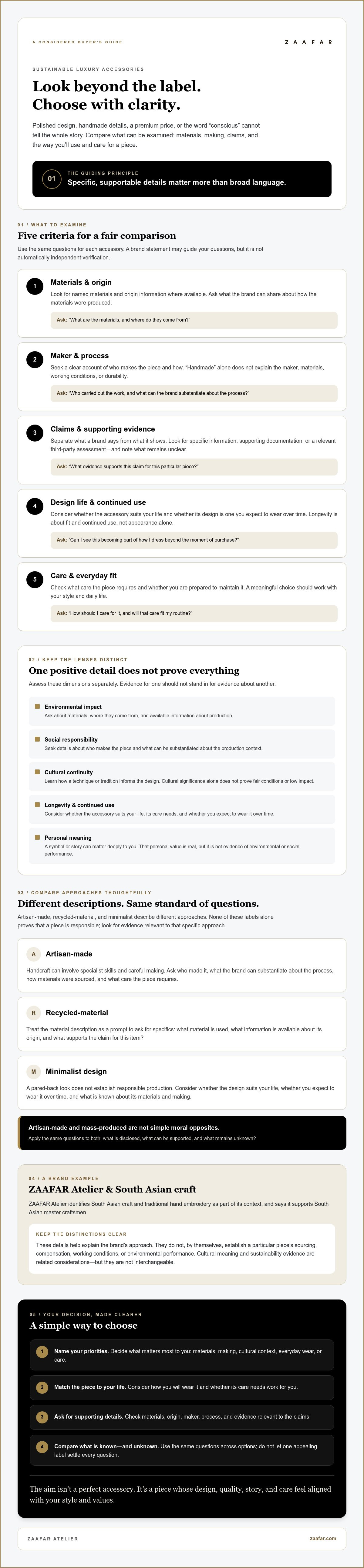
Assess each dimension separately. They are connected, but evidence for one shouldn’t stand in for evidence about another:
- Environmental impact: Ask what the materials are, where they come from, and what information the brand can provide about their production.
- Social responsibility: Seek clear details about who makes the piece and what the brand can substantiate about the production context.
- Cultural continuity: Craft traditions may carry knowledge across generations. Learn how a technique or tradition informs the design, without assuming cultural significance proves fair conditions or low impact.
- Longevity and continued use: Consider whether the accessory suits your life, how it should be cared for, and whether the design is one you expect to wear over time.
- Personal meaning: A symbol or story may make a piece deeply meaningful to you. That value is real, but it isn’t the same as evidence of environmental or social performance.
A brand’s stated values can help you decide what to ask, but they aren’t automatically independent verification. Look for specific information, supporting documentation, or relevant third-party assessment. Make a note of what remains unclear so you can compare what each brand actually provides.
Why does “handmade” not answer every sustainability question?
Handcraft can involve specialist skills and careful making, but the word alone doesn’t tell you who made an item, how its materials were sourced, what working conditions are like, or how well the piece will hold up. Ask who carried out the work, what the brand can substantiate about the process, and what care the accessory requires.
Nor are artisan-made and mass-produced pieces simple moral opposites. Production methods vary, and neither label answers every question about materials, labor, durability, or use. A more useful comparison is to apply the same questions to both pieces: what is disclosed, what can be supported, and what remains unknown? Then consider whether the design has a place in your life beyond the moment of purchase.
Five Criteria for Comparing Sustainable Luxury Accessories
To compare two pieces fairly, give them the same questions rather than letting different brand language set the terms. Sustainable luxury accessories are easier to assess when you separate what a brand says from what it shows. The European Parliament’s briefing on the Environmental impact of the textile and clothes industry offers wider context. For an individual accessory, focus on the information relevant to its own materials and making.
What should buyers ask about materials and making?
Start with the material list and any information about origin. Then ask who makes the piece, what process is involved, and how the brand describes its relationships with makers. Details can vary from one product to another, so don’t treat a broad brand statement as evidence for every item. For example, ZAAFAR Atelier identifies South Asian craft and traditional hand embroidery as part of its context, and says it supports South Asian master craftsmen. These details help explain the brand’s approach, but they don’t establish sourcing, compensation, or environmental performance on their own.
| Criterion | Useful evidence | Follow-up question |
|---|---|---|
| Materials | Named materials and documented origin where available | Can you clarify where these materials come from? |
| Maker and process | A clear account of who makes the piece and how | What can you substantiate about the craft relationship? |
| Design life | Style and construction suited to repeated use | Can I see myself wearing this with what I own? |
| Care | Specific care guidance and any available maintenance information | How should I care for it, and what happens if it needs attention? |
| Claim transparency | Specific explanations or supporting documentation for claims | Which details are verified, and which are brand-stated? |
How can longevity and transparency inform a comparison?
Design life is personal as well as practical. Consider whether each accessory suits your routines, wardrobe, and occasions rather than assuming a classic look guarantees years of wear. Check for care guidance, including instructions for storing, cleaning, or handling the piece. If repair, maintenance, or end-of-life options aren’t described, record them as unknown and ask. Missing information isn’t proof of poor practice, but it limits what you can confidently conclude.
Apply the same standard to both options. A short, specific answer can be more useful than an expansive promise. Unanswered questions also help you see where the available evidence stops, so you can decide whether to seek more information or move on.
Use this checklist: compare materials, maker and process, design life, care, and claim transparency. To see how these ideas appear in a real design context, explore ZAAFAR Atelier’s handmade accessories.
Artisan-Made, Recycled, or Minimalist: Which Accessory Approach Fits?
Each approach highlights a different consideration. Artisan-made design draws attention to skill and process; recycled materials invite questions about content and origin; minimalist design may suit a wardrobe built around repeat wear. None guarantees a lower-impact or more responsible accessory on its own. When comparing sustainable luxury accessories, weigh the details behind each approach against your intended use instead of treating one label as a verdict.
When might artisan-made accessories be the right fit?
Choose an artisan-made piece if you value distinctiveness, specialist skills, or techniques rooted in a particular craft tradition. Then look beyond the handmade description: ask who makes the accessory, how the work is carried out, and what the brand can substantiate about its relationships with makers. Some details may not be available, so distinguish what’s stated from what’s confirmed.
ZAAFAR Atelier describes its handmade jewelry and Artwear as drawing on South Asian craftsmanship and traditional hand embroidery. The brand reports supporting South Asian master craftsmen. That context can help you understand the craft perspective behind its work, but it doesn’t by itself establish material origins, compensation, working conditions, or environmental impact.
How do material choices and minimalist design compare?
For an accessory made with recycled content, seek documentation that identifies the material and the proportion used. A recycled-material claim may clarify composition, but it doesn’t answer separate questions about labor, production, durability, or care. Likewise, natural materials such as Rudraksha beads or quartz may be meaningful design choices, but their natural origin alone doesn’t prove a smaller environmental impact. Look for evidence specific to the item.
Minimalist design offers a different test: can you imagine wearing the piece with clothes you already own and on more than one kind of occasion? Versatility may make it easier to choose an accessory you’ll reach for repeatedly, but that’s a wardrobe consideration, not a measured impact claim. An expressive design may be a better fit if you want a distinctive piece for particular moments.
- Artisan-made: Consider the technique and maker information; ask what the brand can substantiate.
- Recycled: Check material-specific documentation, then assess labor and longevity separately.
- Minimalist: Consider how easily the design fits your wardrobe and intended use.
The best fit depends on the evidence available, what matters to you, and how you expect to wear the accessory. ZAAFAR Atelier also describes Rudraksha beads and quartz among its intentional materials. Treat these as design details to explore, not proof of sustainability. A considered choice begins with the questions the available information can answer.
How to Choose an Accessory You Will Wear and Care For
A thoughtful purchase begins with your real life, not an abstract ideal of a perfect wardrobe. Sustainable luxury accessories should suit how you dress, what you enjoy wearing, and the level of care you can give them. A piece you wear often because it feels comfortable and personal may be a better fit than one chosen only for a compelling description.
How do you match an accessory to real life?
Ask yourself when, where, and how often you expect to wear it. An everyday piece may need to work with several outfits and feel comfortable through a typical day. Occasion-focused jewelry or expressive Artwear may serve a different purpose: creating a distinct look for selected events. That can be meaningful if it matches how you actually plan to use it. For example, consider whether a piece such as the Festive Royalty Necklace fits the occasions and styling you have in mind. Its name alone won’t tell you how often you’ll wear it.
Check whether its scale, fastening, feel, and visual character suit your preferences, using product details where they’re provided. Think about personal symbolism, too. A design that resonates with you can feel lasting, but the practical test is whether you can picture it alongside clothes you already own and in situations you actually expect.
What should you verify before making a purchase?
Use this four-step process to turn interest into a considered choice:
- Define the use: Decide whether you want an everyday accessory, an occasion piece, or expressive Artwear. Name the settings and outfits you have in mind.
- Shortlist your criteria: Choose what matters most, such as material information, craft, comfort, styling versatility, or personal meaning.
- Request evidence: Review product-specific materials, dimensions, care guidance, and sourcing details where available. Ask the brand about material origins or production details that remain unclear.
- Make your decision: Weigh the available information against your priorities. If an answer is missing, treat it as unknown rather than filling the gap with an assumption.
Care instructions deserve a close read. Confirm how the accessory should be stored, cleaned, or handled, and ask about any product details that could affect your decision. For a piece you expect to wear often, consider whether its care needs fit your routine. If information about sourcing or production isn’t available, that doesn’t prove poor practice, but it does mean you have less evidence to assess.
For a closer look at a considered handmade design, explore ZAAFAR Atelier’s handmade accessories.
How ZAAFAR Atelier Brings South Asian Craft into Luxury Accessories
ZAAFAR Atelier is a Hamburg- and Pakistan-based luxury accessories brand owned and designed by Saadia Zaafar. Its offerings include handmade jewelry and Artwear, with the brand describing South Asian craftsmanship and traditional hand embroidery as part of its creative context. For shoppers considering sustainable luxury accessories, that craft story offers a perspective to explore, not a substitute for checking product-specific material, sourcing, or production details.
What makes ZAAFAR’s approach distinct for considered-accessory shoppers?
The brand brings traditional hand embroidery into a contemporary design language shaped by spiritual themes and personal meaning. Rudraksha beads and quartz are among the intentional materials described in its work. These details may resonate with someone seeking an accessory as wearable art or a personal reminder, but they don’t establish environmental benefits or health outcomes.
ZAAFAR describes its jewelry technique as patented and communicates a gratitude-led concept. Treat these as elements of its design story. Before drawing technical conclusions, check the brand’s precise description of what the patent covers. The brand also reports supporting South Asian master craftsmen and preserving traditional hand embroidery. That statement provides useful context, but alone doesn’t verify artisan compensation, working conditions, or the impact of a particular piece.
How can shoppers explore the collection thoughtfully?
Approach each item as its own decision. Read the available product details and compare materials, dimensions, care guidance, and any information about sourcing or making with the criteria established earlier in this guide. If a point matters to you and isn’t explained, consider asking the brand for clarification. Missing information is a reason to pause or inquire, not proof of a particular practice.
Intentional adornment can hold personal meaning without making a sustainability claim. A piece may serve as a reminder, express a connection to craft, or bring a distinctive presence to an outfit. Your own preferences matter, too: consider how you expect to wear it and whether it fits your wardrobe and care habits.
Readers interested in mindfulness jewelry may want to explore that theme alongside the brand’s craft story, keeping personal symbolism distinct from environmental evidence. When you’re ready, take an unhurried look at ZAAFAR Atelier’s handmade jewelry and Artwear on the brand’s homepage, and review the details of each piece for yourself.
Choose With Clarity, Then Wear With Intention
Sustainable luxury accessories are best considered through specific details, not a premium label or a single appealing claim. Compare materials, makers and process, design life, care guidance, and transparency using the same questions for each piece. Then weigh the evidence alongside a practical consideration: whether you’ll enjoy wearing and caring for it in your own life.
Craft, cultural context, and personal meaning can make an accessory distinctive, but they don’t replace product-specific information about sourcing or production. ZAAFAR Atelier is owned and designed by Saadia Zaafar, and its offerings include handmade jewelry and Artwear. The brand reports supporting South Asian master craftsmen, a detail shoppers can consider while continuing to assess what is known about each piece.
If you’re drawn to expressive design and handmade craft, explore the collection and product details at your own pace. Explore ZAAFAR Atelier’s handmade jewelry and Artwear, and let your questions guide a choice that feels considered, personal, and true to your style.
Frequently Asked Questions
What makes a luxury accessory sustainable?
A luxury accessory is more credibly described as sustainable when its material choices, making, expected useful life, and related claims can be assessed through specific information. Consider environmental impact, social responsibility, and durability separately, since evidence for one doesn’t confirm the others. Premium pricing, natural materials, or skilled handcraft may be relevant details, but none alone establishes how a piece was sourced or produced.
How can I tell if a sustainable luxury brand is genuinely ethical?
Look for clear, product-specific details about materials, makers, and production, then distinguish documented information from brand-stated values. Ask who makes the piece, what the brand can substantiate about its craft relationships, and whether any relevant third-party verification is available. If an answer is missing, treat it as unknown rather than assuming either good or poor practice. Ethical sourcing involves more than a polished brand story.
Are handmade accessories automatically more sustainable?
No. Handmade production can reflect specialist skill and human-led craft, but it doesn’t automatically establish material origins, working conditions, environmental impact, or durability. Ask who made the accessory, what process was used, and what the brand can support with evidence. Compare the answers with those for other pieces using the same criteria. The word “handmade” is a useful starting point for questions, not a complete sustainability assessment.
What should I look for when buying sustainable luxury accessories?
Compare materials and any available sourcing information, who makes the piece and how, whether its design suits repeated wear, the care it requires, and how clearly claims are supported. Ask for product-specific details instead of relying on broad labels. Sustainable luxury accessories should also fit your wardrobe and intended use; a piece you value and expect to wear may make more sense for you than one chosen for a claim you can’t verify.
Are natural stones and beads an environmentally friendly choice?
Not automatically. Natural materials such as quartz or Rudraksha beads may carry aesthetic or personal meaning, but their natural origin alone doesn’t establish their environmental impact. To assess a particular accessory, look for information about the material’s composition and origin, and ask what documentation is available. Keep that evidence separate from questions about who made the piece, working conditions, and how it may hold up with care.
Can luxury accessories be worn every day?
That depends on the design, your routine, and the care guidance for the individual piece. Before choosing it for daily wear, check available information about its materials, dimensions, fastening, and recommended care. Consider comfort and whether it works with clothes you already wear. Some jewelry or Artwear may be intended for more expressive or occasion-focused styling, so don’t assume every luxury accessory suits the same use.
How do I compare artisan jewelry with mass-produced accessories?
Use the same questions for both: what materials are used, where are they from, who makes the piece, what production details are disclosed, and does the design suit your intended use? Artisan work may offer a connection to specialist skills or traditional techniques, but the label doesn’t establish ethical conditions or lower impact. Production scale alone isn’t a verdict either. Compare the evidence available and note what remains unclear.