
Protective Talisman Jewelry: Meaning, Materials, and How to Choose
What does protective talisman jewelry mean when it cannot promise supernatural safety? For many wearers, its value lies in the intention they bring to it, the story behind its symbols, and the reminder it offers in everyday life.
If you’re drawn to jewelry that feels like more than an accessory, look for a piece that reflects your values without relying on exaggerated protection claims. Meaning can come from a symbol’s context, the care behind its making, and the way it fits into your life.
This guide explains how talisman jewelry can express personal meaning, what to consider in materials and craftsmanship, and how to choose a design that feels authentic and wearable. It also offers a grounded way to think about symbols and spiritual claims, so you can make a considered choice with respect for their origins.
At ZAAFAR Atelier, handmade jewelry is conceived as wearable art and a personal reminder to practice gratitude. The Midline Copper Bracelet - Minimalist Protection Talisman brings that idea into view: not as a guarantee, but as an invitation to wear intention with care.
Key Takeaways
- Protective talisman jewelry can carry cultural, spiritual, or personal meaning, but a symbol’s interpretation isn’t universal.
- Consider materials and craftsmanship as part of a piece’s story, not as proof of scientifically established protective effects.
- Choose with intention: explore the symbolism, assess the design, and consider whether it feels comfortable and suits your everyday style.
- ZAAFAR Atelier’s handmade approach brings contemporary design together with South Asian craftsmanship and a patented hybrid-jewelry technique.
What Is Protective Talisman Jewelry, and What Can It Mean?
Protective talisman jewelry is worn for personal meaning, symbolism, or intention. A design might represent a spiritual belief, reflect a cultural tradition, or serve as a private reminder of a value the wearer wants to keep close. Meanings aren’t universal: the same symbol can have different associations across communities and individuals. A brief overview of the history and varied uses of the Talisman offers context, but no single interpretation speaks for everyone.
A talisman’s meaning can emerge from its symbol, the care behind its making, and the intention its wearer brings to it. That meaning may be shaped by inherited stories, spiritual practice, personal memory, or simply the feeling a piece evokes. Understanding these distinctions helps you approach a talisman with curiosity and respect instead of assuming that a design has one fixed meaning.
How is a talisman different from an ordinary charm?
A talisman is often understood as an object associated by its wearer with a particular symbol, material, or story. A charm may be chosen mainly for decoration, while a talisman can also hold a personal or spiritual intention. Neither way of wearing jewelry is inherently more meaningful. One person may connect a motif to a tradition; another may simply find it beautiful. Interpretations vary across traditions, communities, and individual experience.
The word has a long history, and talismans have been understood and used in different ways across cultures. That history can deepen appreciation, but it’s worth distinguishing documented context from assumptions. If a symbol has a specific cultural or religious significance, learning about that context is more thoughtful than relying on simplified claims or treating its meaning as universal.
Can jewelry feel protective without promising protection?
Yes. Protection can describe a symbolic or emotional intention rather than a measurable outcome. A bracelet might remind you of courage before a challenging conversation, or a pendant might bring gratitude to mind during a busy day. The jewelry doesn’t guarantee safety or supernatural protection; it can hold meaning and prompt reflection.
This distinction allows protective talisman jewelry to feel spiritually resonant while remaining grounded. A piece may offer comfort because of what it represents, while practical decisions and ordinary precautions remain essential. Its value can lie in the pause it invites: a touch of the charm, a remembered intention, or a moment to return to yourself.
Symbols, Materials, and Craft: What Gives a Talisman Its Meaning?
Material shapes a talisman’s appearance and feel, while its significance depends on the wearer and its context. Copper, Rudraksha, and quartz carry associations for some people, but those associations vary. They are interpretations, not scientifically established protective properties. A material’s symbolic meaning can resonate personally, but it doesn’t demonstrate an evidence-based physical effect.
What do copper, Rudraksha, and quartz represent to some wearers?
Copper’s warm tone and long history in objects and adornment may feel grounded or elemental to some wearers. Rudraksha beads have religious significance in Hindu devotional contexts, including traditions associated with Shiva, though their meaning and use are not identical across all communities. Quartz appears in contemporary spiritual practices, where individuals may give it personal or symbolic associations. None of these materials can be said to prevent harm, heal illness, or change outcomes. Before repeating a symbol’s meaning, look for cultural context rather than treating one interpretation as universal.
A material’s symbolic associations can enrich a talisman’s story, but they aren’t evidence of a physical or supernatural effect. This distinction leaves room for personal meaning without overstating what jewelry can do.
Why does craftsmanship matter in meaningful jewelry?
Craft is part of what makes a piece feel considered. A surface’s finish, the rhythm of a hand-worked detail, and the way materials meet shape its visual character and how it feels to wear. These choices also make the maker’s skill and attention visible. A talisman can hold meaning through its making, not only through a motif or material.
ZAAFAR Atelier brings contemporary spiritual expression together with South Asian craftsmanship. Its handmade jewelry and Artwear support South Asian master craftsmen and help preserve traditional hand embroidery techniques. The atelier’s patented technique creates hybrid jewelry conceived as a charm and a reminder to practice gratitude. The result brings together skilled craft and space for the wearer’s own intention.
The Midline Copper Bracelet - Minimalist Protection Talisman offers an example of a piece named around both material and meaning. Its title can invite reflection without implying that copper provides guaranteed protection. Explore handmade talisman jewelry as wearable art shaped by material, making, and intention.
How to Choose Protective Talisman Jewelry That Feels Personal
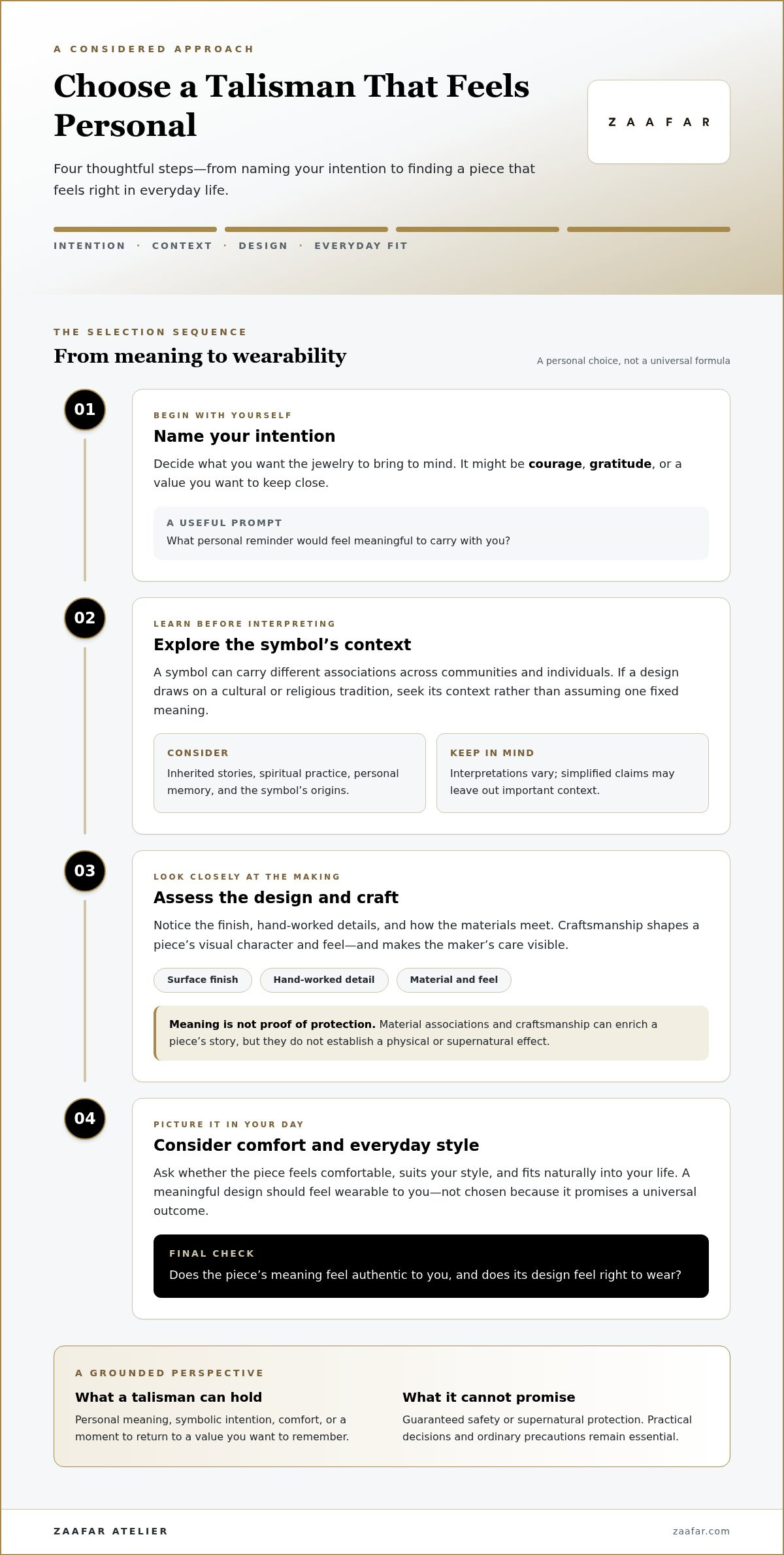
Choosing protective talisman jewelry is less about finding a symbol with a universal promise and more about selecting a piece whose meaning, design, and feel suit you. Use this sequence to make the decision clearer: define your intention, understand the symbolism, assess the design, then consider how comfortably it fits your life.
- Name your intention. Decide what you want the jewelry to remind you of, such as courage, gratitude, or connection.
- Explore the symbol’s context. If it draws on a particular cultural or spiritual tradition, learn about that background and avoid assuming one meaning applies to everyone.
- Assess the design. Notice the shape, scale, materials, and details, and whether they feel right for your personal style.
- Think about wearability. Consider comfort, how the piece fastens, when you plan to wear it, and any care it may need.
Which symbol or intention feels right for you?
Begin with the quality you want to keep close. A piece might remind you to meet a new chapter with courage or to pause and return to gratitude during a full day. Consider whether a symbol genuinely resonates with you, rather than choosing it because a trend presents it as powerful. If its meaning comes from a specific tradition, take time to understand that context. Your personal connection matters, but it doesn’t erase the symbol’s wider history or make your interpretation the only one.
How can you balance meaning with everyday style?
Let the occasion and your own sense of proportion guide the form. A discreet bracelet, necklace, or ring may sit easily within a daily wardrobe, while expressive Artwear can become a focal point for a gathering or an individual look. Neither approach is more meaningful. Consider whether a statement piece feels balanced with your clothing or whether a subtler design is the one you’ll reach for most often. If you layer pieces, notice how their shapes and visual weight work together.
Practical details matter, too. Consider whether a closure feels manageable, whether the piece sits comfortably during the activities you have in mind, and what care its materials require. Jewelry doesn’t all need the same handling, so follow care guidance for the specific piece. For more ideas on bringing meaningful adornment into a daily wardrobe, explore this guide to intentional jewelry pieces.
The right choice doesn’t need to follow a trend or make a grand claim. Look for a considered design you enjoy wearing, with a story or intention you can hold in your own way.
What Protective Talismans Can, and Cannot, Promise
Protective language can describe the meaning someone gives a piece, but it shouldn’t be mistaken for a guarantee. A talisman is jewelry, not a substitute for practical safety measures. Wearers may still find comfort, spiritual significance, or a grounding reminder in it. Those personal experiences can be respected without presenting them as scientific evidence that the jewelry prevents harm.
Is spiritual protection jewelry proven to keep someone safe?
No. Jewelry shouldn’t be described as proven physical protection. A bracelet might remind its wearer to act with courage, or a pendant may hold meaning within a personal spiritual practice. The reminder and comfort can be real to the person wearing it, while remaining distinct from a measurable protective effect. You can value a talisman without asking it to promise what it can’t substantiate.
This distinction matters in everyday decisions. A piece may be part of a meaningful ritual, but it can’t replace appropriate precautions or practical action. Clear language makes space for different beliefs while avoiding claims that turn symbolism into a guarantee.
How can you avoid oversimplified cultural symbolism?
Start with context. Name a tradition only when reliable information supports that attribution, and remember that South Asian cultures and practices are diverse, not interchangeable. A motif may have different meanings across communities, or appear in a contemporary design without claiming to represent a particular tradition. Describe what you can accurately observe about the piece and its craft; don’t present a broad cultural label as a complete explanation.
Respectful interpretation also means using familiar words such as “ancient,” “sacred,” or “protective” carefully. Look for what is known about a symbol’s origin and use instead of relying on a simplified description. For further context, read about ancient protection symbols and their modern resonance.
At ZAAFAR Atelier, intentional adornment brings contemporary spiritual design together with South Asian craftsmanship. The handmade approach honours the skill involved in making a piece, while its meaning remains personal to the wearer. This is a grounded way to approach protective talisman jewelry: appreciate the design and its story, keep claims measured, and let the object serve as a reminder rather than a promise.
Explore ZAAFAR Atelier’s intentional jewelry for adornment shaped by craft and personal meaning.
Discover a Considered Approach to Protective Talisman Jewelry
At ZAAFAR Atelier, handmade jewelry and Artwear bring contemporary spiritual design into conversation with South Asian craftsmanship. Each piece can be appreciated as adornment and wearable art, while its personal significance is shaped by the wearer. This approach offers a grounded perspective on protective talisman jewelry: symbolism and intention can be meaningful without promising guaranteed protection.
How can a piece become a daily reminder of gratitude?
You might connect a piece of jewelry with an intention: a moment to pause, recall what matters, or meet the day with gratitude. The object doesn’t create a particular feeling on demand. Instead, it can serve as a familiar prompt, much like a keepsake that brings a memory to mind. ZAAFAR Atelier’s patented technique creates hybrid jewelry conceived as a charm reminding wearers to practice gratitude.
The Midline Copper Bracelet - Minimalist Protection Talisman is one example of this approach. Its name brings material and talismanic intention together, but it isn’t a claim that the bracelet guarantees safety or changes events. A wearer can decide what the piece represents in their own life, whether that’s appreciating a small daily moment or returning to a personal value.
For a closer look at the bracelet’s design and craft story, explore the copper talisman bracelet guide. It offers a focused perspective on how a specific piece can bring together adornment, symbolism, and intention.
Where does the atelier’s design approach meet personal meaning?
Contemporary spiritual design meets South Asian craftsmanship in work that honours present-day expression and skilled handwork. ZAAFAR Atelier supports South Asian master craftsmen and helps preserve traditional hand embroidery techniques. These details give the jewelry and Artwear material and cultural context, while leaving space for each wearer’s own relationship with the finished piece. Craft is not simply a backdrop to symbolism; it is part of the object’s character.
Meaningful adornment doesn’t need an extraordinary promise. It can begin with thoughtful making, a design that feels true to your style, and an intention you choose to carry. To discover more of this approach, explore ZAAFAR Atelier’s intentional jewelry.
Choose a Meaningful Piece to Carry Forward
The meaning of protective talisman jewelry can begin with a symbol or intention that resonates with you, then deepen through thoughtful design and skilled making. Material associations may enrich a piece’s story, but they aren’t proof of protection. A talisman can be a personal reminder, not a guarantee or substitute for practical safety.
At ZAAFAR Atelier, Saadia Zaafar’s designs bring contemporary spiritual expression together with South Asian craftsmanship. A patented technique creates hybrid jewelry intended to remind the wearer to practice gratitude. The atelier also supports South Asian master craftsmen and the preservation of traditional hand embroidery, connecting personal adornment with respect for the hands and knowledge behind it.
Choose a piece for the meaning you give it, how it feels to wear, and the craft you value. Let its presence invite reflection, without asking it to promise more than jewelry can. Explore intentional jewelry by ZAAFAR Atelier and find a design that feels true to you.
Frequently Asked Questions
What is protective talisman jewelry?
Protective talisman jewelry is worn for personal meaning, symbolism, or intention. A piece might reflect a spiritual belief, connect its wearer with a tradition, or serve as a reminder of a value such as courage or gratitude. Its meaning isn’t universal, and “protective” shouldn’t be taken as a promise of safety. Understanding a symbol’s context can help you appreciate the piece thoughtfully and decide what it means to you.
Does talisman jewelry really protect you?
Talisman jewelry hasn’t been proven to provide physical protection, and it shouldn’t replace practical safety measures. Wearers may find comfort, spiritual meaning, or a grounding reminder in a piece, and those personal experiences can matter without serving as scientific evidence. A bracelet, for example, might remind you to approach a difficult moment with courage. Its value can lie in that intention, not a guarantee that it will prevent harm or change events.
What materials are used in protective talisman jewelry?
Materials vary by design and maker. Copper, Rudraksha beads, and quartz are used in some forms of intentional jewelry, but their associations depend on personal beliefs and cultural context. ZAAFAR Atelier works with intentional materials such as Rudraksha beads and quartz, and offers the Midline Copper Bracelet - Minimalist Protection Talisman. These materials can contribute to a piece’s appearance and story, but they aren’t proven to heal illness, prevent harm, or alter outcomes.
How do I choose a talisman that is meaningful to me?
Start by naming the quality or intention you’d like the piece to remind you of, such as gratitude, courage, or connection. Then learn about the symbol’s context, especially if it comes from a particular cultural or spiritual tradition. Consider the design, how it fits your personal style, and whether it feels comfortable for the occasions you have in mind. Choose a meaning that resonates with you, rather than relying on trend-driven claims.
Can I wear protective talisman jewelry every day?
You can wear a piece regularly if it feels comfortable and suits your routine. Consider how it sits on your body, whether its closure is easy to manage, and whether its design suits the activities you plan to do while wearing it. Materials and construction can have different care needs, so follow guidance specific to the piece. Daily wear can make a talisman a familiar personal reminder, but it doesn’t guarantee protection.
What is the difference between a talisman and an amulet?
The terms can overlap, and their meanings vary across histories and traditions. A common distinction describes a talisman as an object intended to attract or encourage a desired quality, while an amulet is often understood as an object worn to ward off harm. That distinction isn’t universal, so treat it as a general guide rather than a fixed rule. For either object, meaning depends on context, belief, and the wearer’s relationship to it.
Is it respectful to wear jewelry inspired by another culture?
It can be approached respectfully by learning about the design’s cultural context and avoiding assumptions that distinct communities share the same symbols or meanings. Identify a tradition only when reliable information supports that connection, and describe the design accurately rather than claiming ownership of a tradition. Consider the craft and the people behind it, too. Curiosity, careful language, and respect for specific histories help you appreciate an influence without flattening it into a generic style.
Can talisman jewelry be both elegant and spiritual?
Yes. Spiritual significance and refined design can sit naturally together. A discreet bracelet or pendant may carry private meaning, while a more expressive piece can make symbolism part of a statement look. ZAAFAR Atelier brings contemporary spiritual design together with South Asian craftsmanship in handmade jewelry and Artwear. Choose a silhouette, scale, and level of detail that feels like you. A piece can be elegant in form and meaningful through the intention you bring to wearing it. Explore ZAAFAR Atelier’s handmade jewelry and Artwear.