
Body Jewelry for Formal Wear: A Refined Styling Guide
What makes body jewelry for formal wear feel polished? It isn’t necessarily a smaller piece. The key is giving the adornment a clear place in the look. It’s natural to wonder whether a distinctive piece will feel elegant or compete with your dress, especially when the neckline, fabric, and event call for different choices. One considered focal point can feel more refined than several accessories vying for attention.
This guide explains how to choose body jewelry for the occasion and style it with intention. Learn how to balance statement pieces with formal clothing, use proportion and placement to create harmony, and pair adornments with different necklines and settings. We’ll also look at how ZAAFAR Atelier’s Artwear brings jewelry and clothing together through handmade design rooted in South Asian craftsmanship. With a thoughtful approach, your chosen piece can do more than complete an outfit. It can carry meaning, invite a second look, and feel unmistakably yours.
Key Takeaways
- For body jewelry for formal wear, start with the outfit’s focal point, then choose an adornment placement that supports its silhouette.
- Open, high, and asymmetric necklines create different styling possibilities. Let the garment guide where the eye travels.
- Compare restrained, sculptural, and expressive approaches against the occasion and outfit rather than treating one mood as universally right.
- Rehearse your complete look before the event, checking how your adornment sits, moves, and works with other accessories.
- Explore how ZAAFAR Atelier’s Artwear brings contemporary adornment together with South Asian craft traditions and considered design.
What Makes Body Jewelry Feel Right for Formal Wear?
Formal body jewelry is adornment styled to complement, not overpower, occasionwear. Its formality depends on more than the piece itself. The garment, event setting, degree of coverage, and overall styling all shape whether an adornment feels polished or out of place. A sculptural detail may suit a clean, understated outfit, while the same visual emphasis could compete with an already ornate garment.
Unlike a conventional necklace or bracelet, body jewelry draws attention to where it meets the body or clothing. A body chain can trace the outline of an outfit; a shoulder adornment brings focus to the upper silhouette; and jewelry integrated with clothing can blur the boundary between accessory and garment. Jewelry’s forms and meanings vary across cultures and history, as this overview of the History and cultural significance of jewelry explores.
Formal styling rests on three anchors: proportion, placement, and restraint. Together, they help a distinctive piece feel intentional rather than like a last-minute addition.
Which body jewelry styles can complement occasionwear?
Think in categories. Body chains create lines across or over clothing, shoulder adornments frame the upper body, and Artwear brings together the language of clothing and jewelry. The Mythic Shoulder Adornment, for example, focuses attention on the shoulder. A statement piece can define a simple garment, but the event, dress, and your comfort still matter. Give the adornment room to register instead of asking it to compete with several other focal points.
How formal is formal? Match adornment to the invitation
Black-tie occasions, evening celebrations, and creative formal events can each invite a different degree of expression. Dress codes also reflect local customs and the nature of the gathering. In a traditional setting, subtle coordination with the outfit may feel at ease. At an artistic event, a more expressive adornment can feel fitting when it relates to the garment’s silhouette and mood.
Use the invitation as context, not as a rigid formula. Consider how much of the piece will be visible, whether it suits the setting, and whether you’ll feel comfortable wearing it throughout the event. Cultural context matters, too: adornment can carry personal or shared meaning, so a considered choice respects both the occasion and the wearer. The strongest body jewelry for formal wear doesn’t simply attract attention; it belongs in the composition.
Match Body Jewelry to Necklines, Silhouettes & Fabric
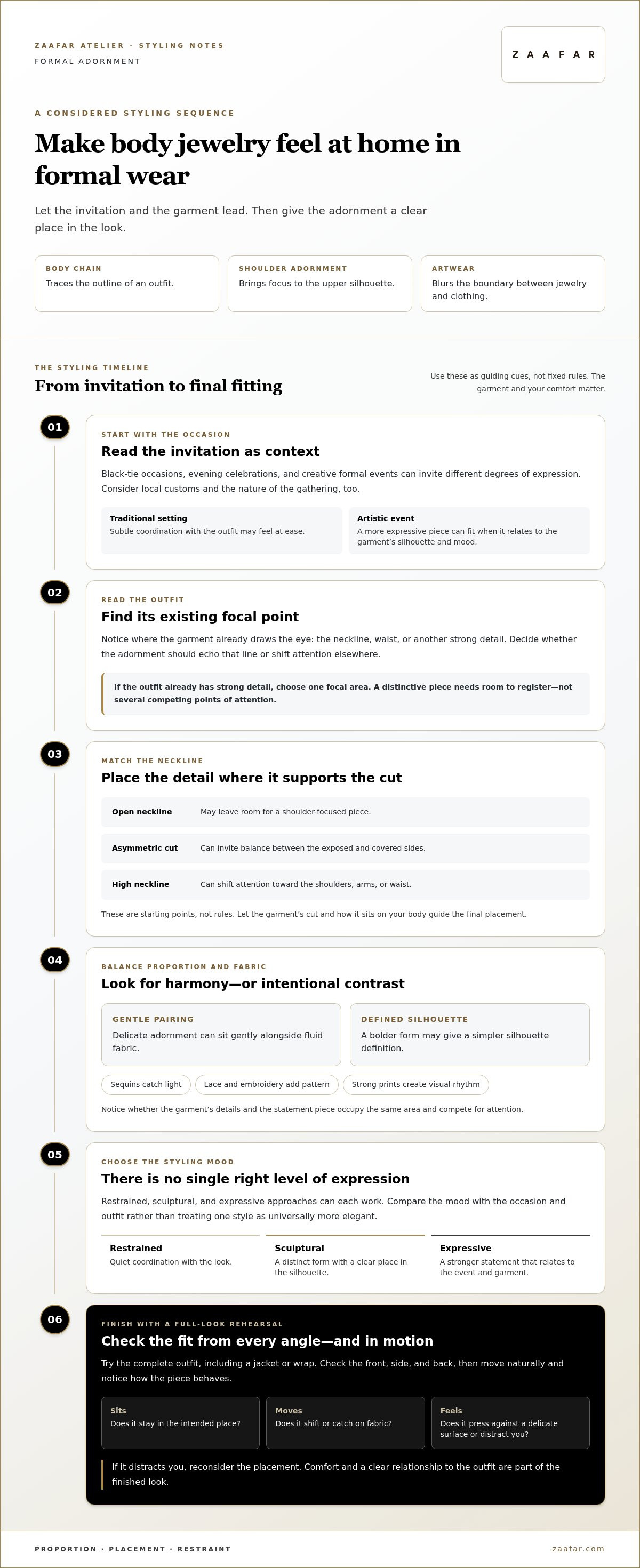
Use a simple sequence to make the styling feel deliberate: identify the garment’s focal point, choose a placement that complements it, then edit your other accessories. If the dress already draws the eye to its neckline or waist, adornment can echo that line or shift attention elsewhere. This gives body jewelry for formal wear a clear relationship to the outfit instead of making it feel like a separate layer.
Start with the neckline. An open neckline may leave room for a shoulder-focused piece, while an asymmetric cut can invite a considered balance between the exposed and covered sides. A high neckline often shifts attention away from the neck and toward the shoulders, arms, or waist. Treat these as starting points, not fixed rules: the garment’s cut and how it sits on your body matter.
Adornments and clothing have long shaped one another; the V&A’s overview of the Evolution of jewelry through history traces how jewelry has changed across periods and social contexts. For your own look, ask where the outfit already holds visual attention and where there’s room for another detail.
Where should body jewelry sit with common formal necklines?
With an open or asymmetric neckline, shoulder adornment can complement the exposed line if it doesn’t interrupt the garment’s structure. A high neckline can make the shoulder, arm, or waist a more natural focus. Try the complete outfit, including any jacket or wrap, and check it from the front, side, and back. A piece that looks balanced when you’re standing still may sit differently once you add another layer.
How do proportion and fabric change the effect?
Consider contrast and visual weight. Delicate adornment can sit gently alongside fluid fabric, while a bolder form may give a simpler silhouette definition. Sequins already catch the light; lace and embroidery bring intricate patterns; strong prints create their own visual rhythm. Any of these details can compete with a statement piece if they occupy the same area.
If a formal outfit already has strong detail, choose one focal area. Then test the outfit in motion. Notice whether the adornment shifts, catches on fabric, or presses against a delicate surface. If it distracts you, reconsider the placement. For a design-led point of reference, explore ZAAFAR Atelier Artwear, where adornment meets clothing in a contemporary expression of South Asian craft.
How to Choose Body Jewelry for a Formal Occasion
Body jewelry can feel formal when the full look is deliberate and balanced. Start with the invitation and the outfit, then choose an adornment that suits the setting, has a clear place in the composition, and lets you move comfortably. A restrained approach isn’t automatically more elegant than a sculptural or expressive one. Each can work when it feels in tune with the event and with you.
Use this comparison as a starting point, not a dress-code rulebook. The garment’s focal point helps guide placement, while the styling mood leaves room for personal and cultural context.
| Occasion | Outfit focal point | Possible placement | Styling mood |
|---|---|---|---|
| Ceremony | Neckline, shoulders, or a meaningful garment detail | Near the focal point, with other accessories kept quiet | Restrained, thoughtfully coordinated |
| Gala | A clean silhouette or open area of the outfit | One deliberate focal area, such as the shoulder or waist | Sculptural or expressive |
| Formal dinner | The neckline or upper silhouette | A position that remains comfortable while seated | Subtle, polished, or gently sculptural |
Which styling approach suits a ceremony, gala, or formal dinner?
For a ceremony, consider the setting and its customs. Understated coordination can support the occasion without drawing focus away from it. At a gala, a statement piece can anchor a simpler silhouette and bring an artistic quality to the look. For a formal dinner, think beyond the mirror: placement should feel comfortable when seated, standing, and moving through the room.
The same piece may read differently across settings. Choose a mood that suits the invitation and feels authentic to your own sense of style.
How can you keep a statement piece from feeling overdone?
Give the eye one dominant focal area. If body adornment is the statement, let the rest of your jewelry stay quieter. Then look at the outfit as a whole: garment details, hairstyle, and the visual weight of other accessories all affect the balance.
Before the event, rehearse the complete look and move naturally in it. Sit, reach, walk, and turn. Check that the piece stays comfortably positioned and doesn’t restrict movement or distract you. This final test helps body jewelry for formal wear feel composed, personal, and at ease.
How to Style and Wear Body Jewelry with Confidence
A polished look should feel as good in motion as it does in the mirror. Before the event, try on the entire outfit and take time to see how each element works with the others. This rehearsal helps you catch small distractions early, from a piece shifting out of place to an accessory competing with the garment.
What should you check before the event?
Use this checklist to assess body jewelry for formal wear as part of the complete ensemble, not in isolation:
- Wear every layer. Include underlayers, shoes, and the jacket, wrap, or coat you plan to wear on arrival. Check whether outerwear covers or presses against the adornment, or changes its position.
- Move naturally. Walk, sit, reach, and turn as you might during the occasion. Notice whether the jewelry stays comfortably positioned, restricts movement, or catches on the garment during ordinary gestures.
- Review the balance. Look at your other accessories alongside the focal piece. Simplify anything that pulls attention away from it or makes the overall look feel crowded.
- Take a few photographs. Photograph the complete outfit from the front, side, and back. Different angles can reveal an imbalance or placement issue that’s easy to miss when looking straight into a mirror.
Comfort is part of good styling. If you’re repeatedly adjusting a piece or worrying about whether it will stay in place, reconsider its position or whether it suits the outfit. Don’t rely on an untested adjustment on the day. Choose a look that feels secure and comfortable during your rehearsal.
How can personal meaning remain part of a polished look?
A meaningful adornment can make formal dressing feel personal, not simply decorative. You might choose a piece for its symbolism, its connection to a memory, or the intention you associate with wearing it. Treat that meaning as a personal reflection or reminder, rather than a promise of a particular outcome. The guide to mindfulness jewelry and intentional adornment offers a deeper perspective on bringing awareness to what you wear.
Let the final choice honour both the occasion and your own sense of self. Explore ZAAFAR Atelier’s considered adornment for further inspiration.
ZAAFAR Atelier Artwear: Formal Adornment with Craft and Intention
At ZAAFAR Atelier, Artwear brings clothing and jewelry into a shared design language. Rather than treating adornment as a finishing touch separate from an outfit, this hybrid approach makes it part of a broader expression. The result can feel like wearable art: considered, personal, and shaped by the meaning its wearer chooses to bring to it.
What makes Artwear distinct from a conventional accessory?
Artwear reflects ZAAFAR Atelier’s approach to hybrid jewelry and expressive adornment. It offers another way to think about formal dressing, where the relationship between a garment and an adornment can be as meaningful as either element alone. The aim is to make room for personal style, not to prescribe a single formula.
That perspective is rooted in the brand’s connections to Hamburg and Pakistan, and in South Asian craftsmanship. ZAAFAR Atelier supports South Asian master craftsmen and the preservation of traditional hand-embroidery techniques. These craft roots give context to the brand’s work without implying that every design uses the same process. Craft can be part of what makes a piece resonant: its making, its cultural references, or the meaning a wearer associates with it.
How can crafted adornment become part of a formal look?
Begin with the event and the garment. Consider its silhouette, focal point, and level of detail, then decide whether an expressive piece feels balanced alongside it. The Heart Shape Bodysuit, Mythic Shoulder Adornment, and Midline Emerald Belt offer different ways to think about clothing and adornment together. Let your own garment, comfort, and sense of proportion guide the choice.
Intentional design can also give an occasion look personal significance. ZAAFAR Atelier’s hybrid jewelry is crafted using a patented technique and serves as a reminder to practise gratitude. It offers an invitation to bring meaning to what you wear, not a promise of a particular outcome. Your own interpretation can be just as individual: a piece may connect with a memory, a tradition, or a quality you wish to carry into the gathering.
The Festive Royalty Necklace is another example of the atelier’s handmade jewelry. To discover more considered adornment, explore ZAAFAR Atelier’s Artwear and handmade jewelry.
Make Your Formal Look Feel Intentionally Yours
The most polished body jewelry for formal wear starts with the occasion and the outfit: choose a placement that complements the silhouette, keep the overall balance in view, and rehearse the look in motion so it feels comfortable as well as considered. A meaningful adornment can add personal expression without asking every accessory to compete for attention.
That thoughtful approach leaves room for craft. Designed by Saadia Zaafar, ZAAFAR Atelier’s handmade jewelry and Artwear draw on South Asian craftsmanship. The brand supports South Asian master craftsmen and helps preserve traditional hand-embroidery techniques, bringing care and cultural roots into contemporary adornment.
Let your choice reflect both the event and what you want to carry with you. Explore ZAAFAR Atelier’s Artwear and handcrafted jewelry for pieces that bring craft and intention into occasion dressing. Your most memorable look is composed, comfortable, and unmistakably your own.
Frequently Asked Questions
Can you wear body jewelry with a formal dress?
Yes, body jewelry can complement a formal dress when its placement and visual weight suit the garment. Look at the dress’s neckline, silhouette, and details, then choose one area to highlight. A simple dress may leave space for a more expressive adornment, while a richly embellished design may call for a quieter accent. Try the full look on and check that the piece feels comfortable as you move.
Is body jewelry appropriate for a black-tie event?
It can be, depending on the event, garment, and styling. For a traditional black-tie setting, a considered, coordinated piece may feel more at ease than several competing statement accessories. An understated look isn’t the only option, but the adornment should feel intentional alongside the rest of your outfit. If the invitation or cultural setting suggests a particular mood, use that context to guide your choice.
How do you style body chains with an evening gown?
First consider the gown’s shape and where a chain would create a clear visual line without competing with its details. A body chain worn over clothing can add definition to a simple, streamlined outfit, while a highly embellished gown may already provide enough visual interest. Rehearse the complete look, including any outer layer, and check whether the chain shifts, catches, or distracts during ordinary movement.
What body jewelry works with a high-neck formal dress?
A high-neck dress often shifts attention away from the neckline, creating an opportunity to consider adornment at the shoulder, arm, or waist. Choose placement according to the garment’s silhouette and existing details, rather than adding jewelry simply to fill space. If the dress has strong embellishment, a restrained accent may preserve balance; a simpler design may leave more room for a sculptural focal point.
Can body jewelry be worn over clothing?
Yes. Wearing body jewelry over clothing can make it an intentional part of the outfit and add definition to a simple or monochrome look. Consider the fabric’s texture and construction, since delicate or embellished surfaces may be more susceptible to catching or friction. Try the piece with the complete outfit, including jackets or wraps, and move naturally to see how it sits from different angles.
How do you keep body jewelry from looking too casual?
Make the styling deliberate: choose a piece that relates to the garment’s silhouette, coordinate its visual weight with the outfit, and keep other accessories edited. The right balance depends on the event and the clothing, not on a single rule. A clean, well-considered composition can help body jewelry for formal wear feel polished, while several competing statement pieces may make the overall look feel busy.
What should you wear with a statement shoulder adornment?
Let the shoulder piece lead. A simpler garment or an uncluttered area around the neckline can give it room to stand out, while a competing necklace or elaborate shoulder detail may divide attention. Consider how your hairstyle and any jacket or wrap change the overall shape. Before the event, check the complete look from the front, side, and back, and confirm that the adornment remains comfortable as you move.
Is body jewelry comfortable to wear for a formal event?
It can be comfortable if the piece feels secure and allows you to move freely. Test it with the outfit before the event: sit, walk, reach, and turn, and notice whether it shifts, presses, or catches on the fabric. If you find yourself adjusting it repeatedly, reconsider the placement or choose a different styling approach. Comfort matters because a polished look should let you be present at the occasion.